At home I run an AI agent on a small server (Hermes). Besides chatting with me on Telegram, it runs 25 scheduled jobs: a sports digest, local events, a weekly TV-series check, a news early-warning summary, a weekly Home Assistant audit, a morning briefing and so on.
Every job was a prompt. At the set time the agent woke up, searched the web, opened pages, retried, wrote a message and sent it. It worked well. It ran on my ChatGPT subscription (about $125 a month), which I also used for chatting with the agent and for coding.
Now I am moving to a smaller Claude subscription, and I need it for programming. Routine jobs should not eat it. So I rewrote them.
How much the agent really used
The agent logs every run. In seven weeks the scheduled jobs used about 1.17 billion tokens. The most expensive one, a daily news early-warning summary, used about 6 million tokens per run.
On a subscription you do not see that. So I compared it with everything else on the same subscription in those weeks: my chats with the agent and my coding agent. The scheduled jobs were about 26–34 % of all tokens, depending on how you count cached tokens. That is roughly $33–43 of the $125 every month.
At API prices the same jobs would cost roughly $170–330 a month. That range is rough: the agent does not log prices on a subscription, so I estimated them from a run of my AI newsletter that I had priced before ($2.71 for one run).
Most of those tokens were not thinking. They were the agent reading the same pages again, finding out what day it is, retrying a blocked site, and saying "nothing new" at the end. Two jobs ended with "nothing new" in more than 90 % of runs.
Fixed code for the routine, a model only for the judgement
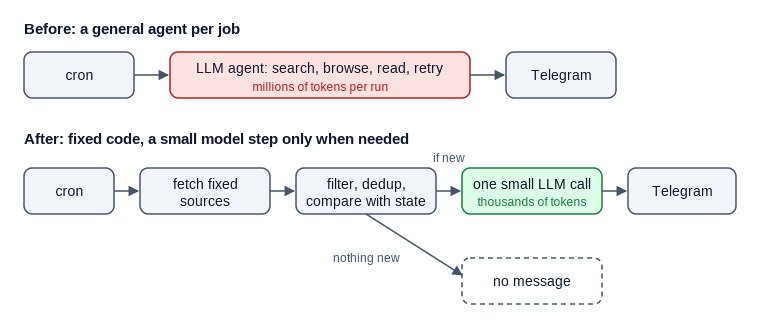
Each job is now a small Python program:
- Fetch fixed sources. RSS feeds, public JSON APIs, or event data that websites already publish for search engines (schema.org JSON-LD). For search I use the free Google News RSS feed.
- Filter and compare with last time. Dates, duplicates and "already sent" are plain code with a small state file.
- Call a model only if something is new. One call with all new items together, a strict output format, and a hard price cap per run (Pydantic AI, DeepSeek V4.1 Flash through OpenRouter).
- Print the message. Hermes still runs the schedule and sends the output to Telegram. Empty output means no message.
Some jobs need no model at all. The sports digest is just APIs and a template. The TV-series check compares a public API with last week.
The result
| Before | Now | |
|---|---|---|
| Share of the subscription | about $33–43 a month (about a third of $125) | — |
| At API prices | roughly $170–330 a month | about $1 a month (estimate) |
| Tokens per run | up to millions | a few thousand, often zero |
| The formerly most expensive job | ~6 M tokens per run | about $0.008 per run |
The $1 is my estimate from the cost of each job's first real runs multiplied by how often it runs. I will know the real number after a month.
Out of 25 jobs, 7 were already simple scripts, 14 were rewritten, 3 I dropped and 1 seasonal job I now do by hand until it ends in December.
What I lost
Not everything fits a fixed program.
- Repairs. The old Home Assistant audit and server audit could fix small problems by themselves. Now they only report, and I do the repair myself. I dropped the server audit completely, because simple health checks already cover it.
- Coverage. The agent could search anywhere. The program reads only the sources I listed. Local events from villages without a machine-readable calendar are gone. Facebook and Instagram need a login, so the program does not read them.
- Flexibility. Changing a prompt was one line. Now a change means code, tests and a review.
For routine jobs that is a good trade. For open-ended work I would still use an agent.
What the reviews caught
I built this with coding agents in about a day. Every batch went through tests, a real run on the server, an independent "tester" agent and two rounds of review. They found real problems:
- One job writes rows into a Google Sheet. Text from a web page went in as "user entered", so a title starting with
=would run as a formula when I open the sheet, and could send data out. Now values are written as plain text. - Links come from the web. A URL with
)in it could break the Telegram message or slip in a different link. All links now go through one function that encodes them. - The news job sent a "no change" message, because it trusted the model's own "changed" flag. Now the code compares the level with yesterday and decides.
- My own security fix (checking every redirect) decoded gzip twice, so every source failed. The tester found it before any job was switched.
None of these were in the first version.
Takeaways
- Look at token logs, even on a flat subscription. The waste is invisible until you count it.
- Let code do what code can do: fetching, dates, duplicates, "what is new". Give the model only the part that needs judgement, once per run, with a price cap.
- Silence is a feature. Most runs should end with no model call and no message.
- Review it like production code. Even a hobby job that writes to your own spreadsheet can be attacked through the data it reads.